
Napoli Believes
(Day 19 of 31 – story crumbs from the world of Loveandpizza.it 🍕)
This post was originally published at the beginning of my 31-day Loveandpizza.it journey. The complete English series is now here for you to explore, one story crumb at a time. 🍕
Napoli believes.
In God, in the saints, in luck, in fate, and above all in the little red horn that hangs from doorways, mirrors, key rings and necklaces all over the city. Here, deep faith and cheerful superstition live happily side by side, and nobody finds that the least bit strange. It’s one of the things I love most about the place.
The little red horn
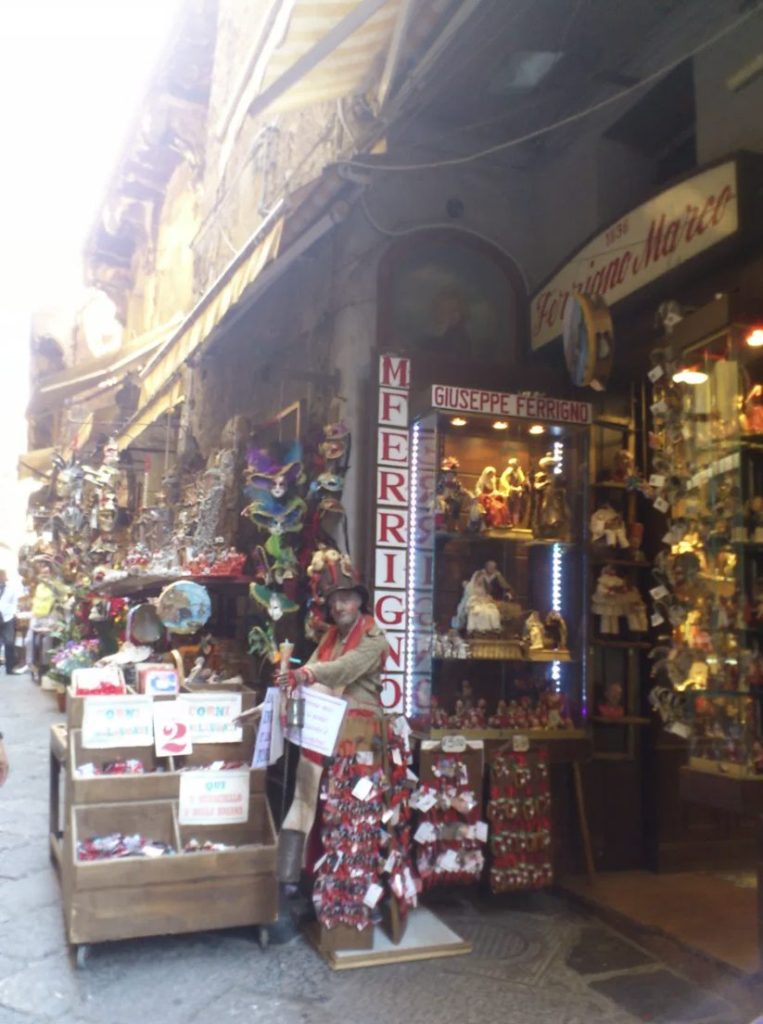
It’s called a cornicello: a small, curved red horn, and it’s everywhere, warding off the malocchio, the evil eye.
Someone will press one into your hand for luck. Someone else will make a discreet hand gesture if you say something that tempts fate. You learn quickly: you do not brag about your good fortune in Napoli. You touch the horn and you stay humble.
Photo above: Corni for sale by the crateful. In Napoli you don’t buy one lucky horn; you buy several, obviously. (Photo from personal files)
Faith you can feel
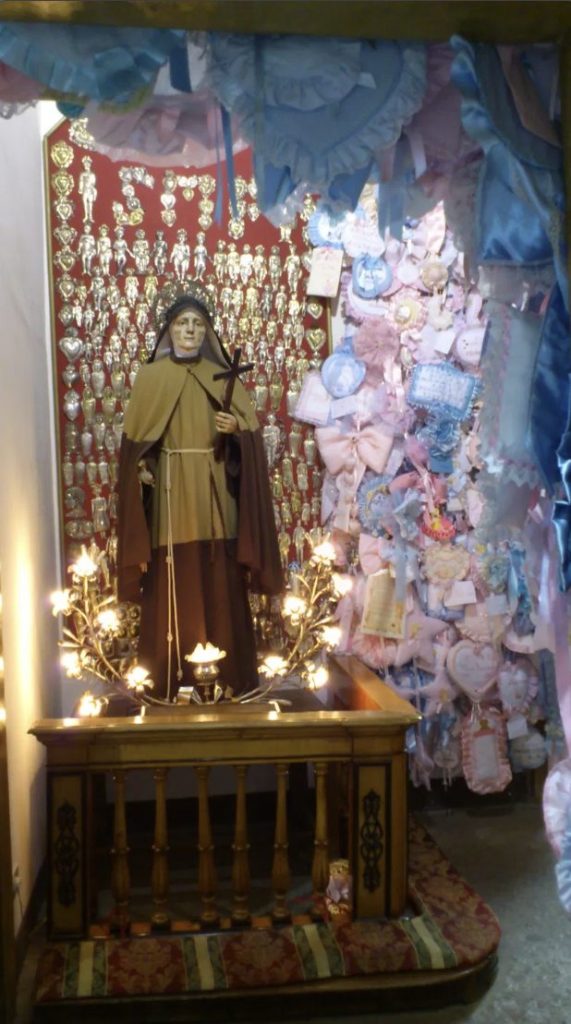
And then there’s the devotion.
Shrines glowing on street corners. Whole neighbourhoods that pray and party in the same breath. And San Gennaro, the city’s patron saint, whose dried blood is kept in a vial and watched, three times a year, by a cathedral full of anxious Neapolitans waiting to see whether it will liquefy. If it does, Napoli is safe for another season. If it doesn’t… well. Nobody likes to think about that.
Walk into any church and you’ll find walls of little silver ex-votos: hearts, hands, arms, legs, babies. Each one a thank-you from someone whose prayer was answered. Hundreds of them, in neat rows, like a wall of quiet receipts.
Carolina, who is Catholic and no stranger to a Sunday Mass, finds Napoli’s particular blend of the sacred and the superstitious both baffling and rather wonderful.
The souls people adopt
And then there’s the one that stopped me in my tracks.
In Napoli there’s an old practice, born in the early 1600s, called the cult of the anime pezzentelle.
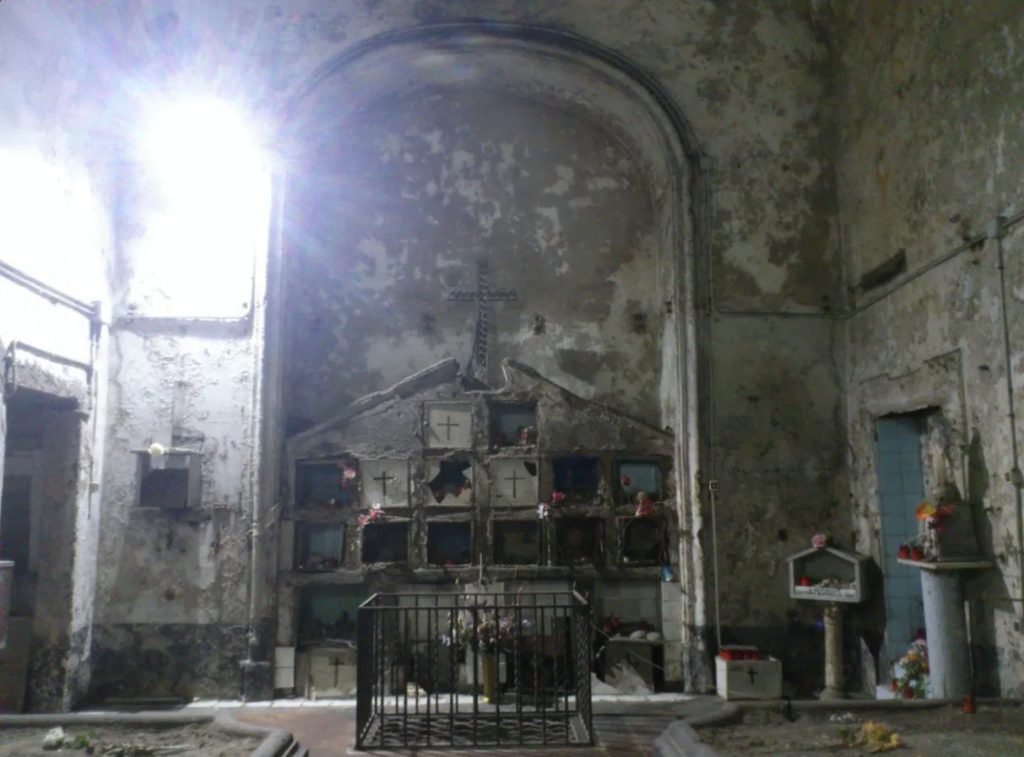
Here’s how it works. In certain churches, and in the Fontanelle cemetery, you’ll find the skulls of the anonymous dead: people buried in common graves, with no name, no family, nobody left to mourn them. A Neapolitan chooses one and adopts it. (The skull, tradition says, is where the soul lives.) You clean it. You give it a cushion, a niche, flowers, a candle, a rosary. You visit. You talk to it.
And in return, you ask. Because it runs both ways: the abandoned soul asks the living for refrisco – relief from the flames of Purgatory – and the living asks the soul for grace, help, a favour. Two lonely parties, striking a deal across the veil between worlds.
It should be macabre. Instead it’s one of the tenderest things I have ever seen: a whole city refusing to let anyone be forgotten, even people whose names nobody knows anymore.
Lucia
And then there’s Lucia.
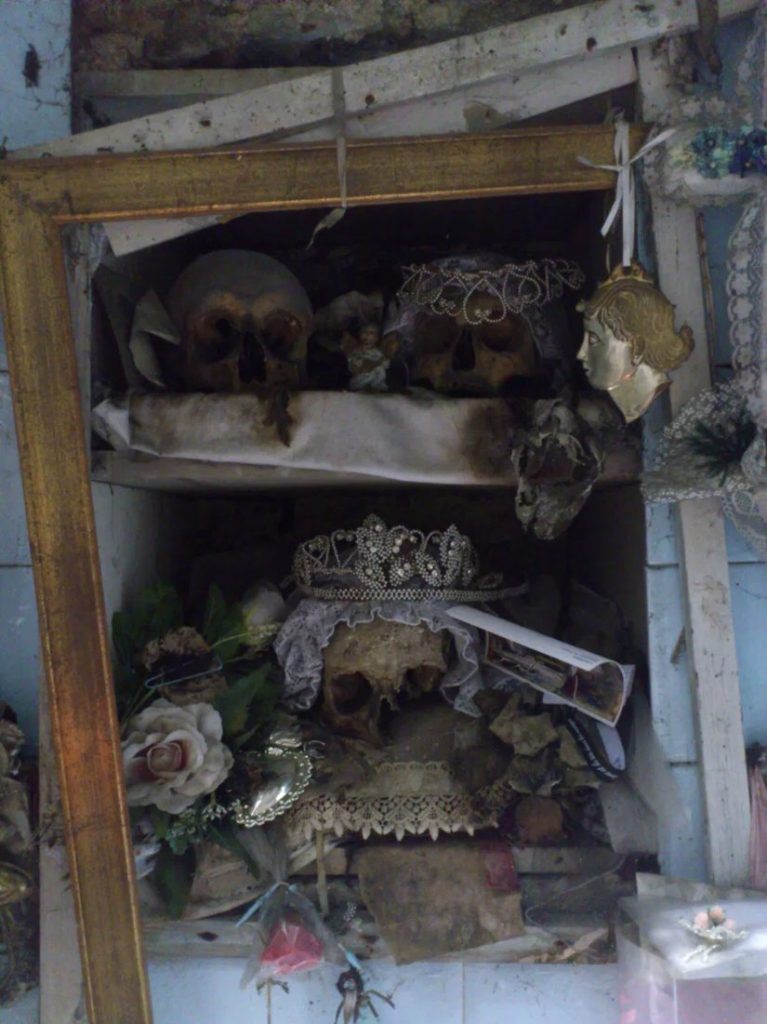
She is, by common agreement, l’anima più amata – the most loved soul in Napoli. Her skull sits in the hypogeum of the Purgatorio ad Arco wearing a bridal veil and a precious crown, flanked by two skulls that popular imagination says are her servants.
Tradition gives her a name: Lucia D’Amore. (Yes. D’Amore. The patroness of brides is called Lucia of Love. I promise I didn’t make that up – I would never dare! Actually, I had goosebumps while walking in the crypt with a guide, listening to the “stories of the skulls” that “live” there) Lucia was the daughter of a prince, and promised in marriage to someone she didn’t love.
And then the story splinters, gloriously, into a dozen versions: she didn’t want to marry him because she already loved someone else, and took her own life. She didn’t want to marry him, and died of a broken heart. She tried to run. She had tuberculosis. She was murdered on her way to the altar. Or – my favourite – she did love him, and drowned on their honeymoon.
Nobody agrees. Napoli never does. The only thing everyone accepts is the sad bit: the young woman never got her wedding.
So they made her the patroness of brides. Of course they did. The girl who never made it down the aisle became the one you ask about love, and the girls of Napoli and all over the world have been coming to her ever since, generation after generation, leaving flowers, notes and little presents, asking her to intercede for them. She’s less a forgotten soul at this point and more a full-blown celebrity, with a queue.
And here’s my favourite part of all: in 1969, the Church actually banned the cult. A cardinal decided things had got out of hand, with far too many Neapolitans praying to anonymous skulls rather than to properly authorised saints.
Napoli, needless to say, carried on. Lucia still has her flowers. 😌
(You may remember her from my post about the real places behind the book. Carolina pays her a visit, too. But that’s a story for the book. ✨)
Dreams, numbers, and a game invented out of spite
Neapolitans famously turn dreams into lottery numbers, and there’s an entire system for it. It’s called La Smorfia – the name most likely comes from Morpheus, the Greek god of dreams.
Every number from 1 to 90 carries a meaning. Dreamt of a cat? There’s a number. A death? A number. A stranger, a soup, a barking dog? Numbers, all of them. Dream something odd and your neighbour will have opinions about which combination you ought to be playing this week. This one is personally amusing, because in Brazil we have something similar called jogo do bicho. 😀
And here’s my favourite part of the whole story. In the 18th century, the authorities banned the lottery during the Christmas holidays: too immoral, apparently, for the season. So Neapolitans, being Neapolitans, simply took the game home and invented their own: tombola, played round the family table every Christmas since, with the caller shouting out the Smorfia’s meanings as he draws each number. Told they couldn’t play, they invented a better game. (And bingo, as the rest of the world knows it, descends from that.)
Honestly? It’s the most Neapolitan story I know.
The whole city runs on a hopeful conviction that meaning is hiding everywhere, if you only know how to read it.
And after a while… so did I. And so did Carolina…
So tell me: are you superstitious? Even a tiny bit? Do you have a good-luck ritual you’d never admit to in daylight? 👇 (No judgement here. I touch wood constantly.)
Dani. x
P.S. Loveandpizza.it is coming back in English, Italian and Portuguese. Save your slice and you’ll be first to know the moment your edition’s ready. 🍕
Still hungry for another slice?
Follow @loveandpizza_it for story crumbs, Napoli discoveries and
beautifully complicated hearts. ❤️🍕

I am superstitious. I cross my slippers when I go to bed to keep ghosts away. I find adopting skulls a little creepy.
I know, right? I mean, while my mother was alive, no shoes would be upside down on my watch! 😅 I found adopting skulls a bit creepy as well, but when I understood the reasons, I was actually moved. 🥹
Dani, this is my first visit to your blog, and there is a lot interesting here! I have never been to Naples. So your descriptions of aspects of Napoli culture are luscious. Now, do I take it you write fiction, and this tour of Italy is background for an upcoming novel? Superstition– not me. But I do lock the door at night and set the alarm. 🙂
Hi Kebba! Welcome to my blog! 🤗I’m so glad you like it. Yes, I write fiction and the tour of Napoli (the whole series of blog posts is here: https://danielapescuma.com/category/loveandpizza-it/
I loved reading about the blend of faith, history and superstition; it makes Napoli feel so wonderfully unique. As for me, I definitely catch myself trying not to jinx things.
Sorry to hear about your tech problems, I can’t imagine blogging on my phone! Kudos to you!
Tamara, Napoli is definitely unique! 🤩 It’s a mix of so many things – no wonder I’m “obsessed” by it! 😅
(P.S. thank God I have my laptop back! 😮💨)